What Is the Best Water Irrigation Hose from China?
Choosing the best Water Irrigation Hose from China requires more than comparing prices or colorful product photos. The right hose must match water pressure, field conditions, fittings, and expected service life. A small vegetable farm needs different performance from a greenhouse, nursery, or commercial landscape project. Wall thickness, reinforcement, flexibility, UV resistance, and temperature tolerance all deserve close attention.
China has a broad manufacturing base, including factories producing PVC, rubber, TPU, and reinforced irrigation hoses. However, quality can vary between suppliers and even between production batches. A reliable evaluation should examine material specifications, pressure ratings, dimensional accuracy, connector compatibility, and factory inspection records. Product samples can reveal important details. Check whether the hose kinks near a metal fitting, leaks after repeated bending, or becomes stiff under sunlight. These practical tests often say more than a sales brochure.
Supplier experience also matters. Established manufacturers may provide technical drawings, batch testing, customization support, and traceable quality procedures. Still, no supplier should be trusted without verification. Ask for clear documentation and test a sample before placing a larger order. There is no perfect choice. Even experienced buyers can overlook storage conditions, shipping damage, or unsuitable connectors. This guide compares the main hose types, performance factors, and sourcing considerations to help buyers make a more informed decision. The final recommendation should reflect actual operating conditions, not simply the lowest quoted price.
Types of Water Irrigation Hoses Made in China
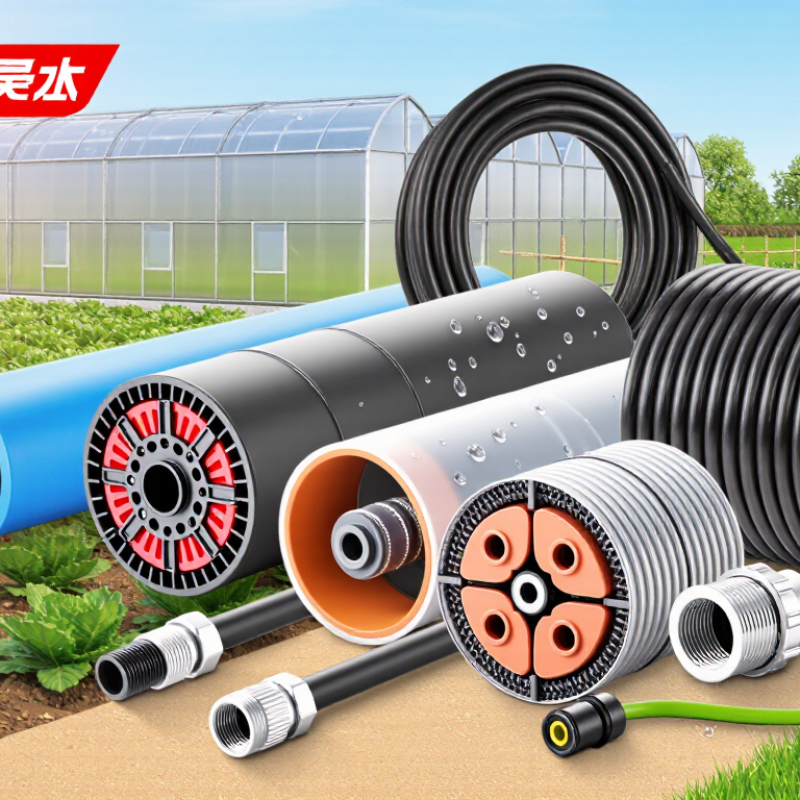
China produces several water irrigation hose types for farms, nurseries, and greenhouse systems. Flexible PVC hoses suit short-distance watering and general farm use. Reinforced PVC hoses handle higher pressure and frequent movement. Lay-flat hoses are easy to store and transport, but sharp stones can damage them. Polyethylene hoses offer better chemical resistance and stable outdoor performance. Drip tape delivers water near plant roots, reducing surface evaporation. FAO AQUASTAT reports that agriculture accounts for about 70% of global freshwater withdrawals. This makes precise irrigation increasingly important.
Each hose type has trade-offs. Drip tape saves water, yet it needs clean filtration and careful pressure control. Soaker hoses provide gentle coverage, but their output may become uneven over long runs. In practical sourcing checks, wall thickness, burst pressure, connector quality, and ultraviolet resistance deserve close attention. A low-cost hose can become expensive after repeated leaks. That is an uncomfortable lesson.
Tips: Match the hose diameter to the pump and field length. Request pressure-test records and material specifications from the manufacturer. Check whether the product meets relevant food-contact or agricultural-use requirements. The International Organization for Standardization provides guidance for irrigation equipment testing, but factory documents still require careful verification. Inspect a sample under sunlight, bending, and pressure before placing a larger order. No hose is perfect. Soil, water quality, and installation habits can change its real service life.
Key Materials and Construction Features to Evaluate
What Is the Best Water Irrigation Hose from China?
A reliable irrigation hose starts with the right material. PVC is affordable, lightweight, and suitable for gardens or short seasonal use. Reinforced PVC handles higher pressure and resists kinking better. Rubber offers stronger flexibility and better performance under temperature changes, but it usually costs more. For larger farms, thermoplastic hoses can provide a useful balance between weight and durability.
Construction quality matters as much as the material. Check the number of reinforcement layers, spiral strength, and inner-wall smoothness. A smooth inner wall reduces friction and supports steadier water flow. Thick outer layers can resist sunlight, abrasion, and contact with rough ground. The hose should also bend without flattening. Small details decide durability. In practical inspections, weak couplings often fail before the hose itself. That point is easy to overlook.
Tips: Ask for pressure, temperature, and burst-test data before ordering. Request samples and bend them repeatedly near the fittings. Inspect the surface for bubbles, uneven thickness, or exposed reinforcement. Confirm whether the hose contains UV stabilizers for outdoor use. Measure the actual inner diameter, not only the advertised size. Some specifications may be optimistic. A supplier with traceable quality records, clear testing methods, and consistent batch samples is easier to evaluate. Still, no material suits every field, so soil, climate, pressure, and storage conditions should guide the final choice.
What Is the Best Water Irrigation Hose from China?
Material and construction performance varies by application. The comparison below uses a practical 1–10 benchmark based on commonly recognized properties of hose materials and reinforced designs, including flexibility, kink resistance, UV durability, abrasion resistance, and pressure capability.
Key takeaway: Reinforced TPU and EPDM constructions generally provide the strongest balance of pressure capability, flexibility, and outdoor durability. PVC remains a cost-effective option, while LDPE is better suited to lightweight, low-pressure irrigation lines.
How to Compare Chinese Irrigation Hose Performance
What Is the Best Water Irrigation Hose from China?
How to Compare Chinese Irrigation Hose Performance
The best irrigation hose is not always the thickest one. I compare hoses through measured performance, field handling, and long-term consistency. Start with the working pressure, burst pressure, and flow rate. A hose should carry water steadily without swelling near connectors. Test it under the pressure used on the farm, not only in a showroom. Small differences become obvious after several hours.
Material inspection matters. Check the inner wall for smoothness, uneven thickness, and visible particles. A smooth inner surface can reduce friction and support more stable flow. For outdoor use, examine UV resistance, temperature tolerance, and flexibility after repeated bending. Pull the hose across dry soil and gravel. Abrasion marks reveal more than a printed specification.
Do not judge one sample too quickly. My early comparisons focused too heavily on wall thickness, and that was a mistake. Reinforcement quality, compound consistency, and connector design often matter more. Request production samples from different batches, then record weight, diameter, pressure loss, and leakage. Keep the same test length and water temperature. Documentation helps, but physical testing remains essential. Some suppliers provide detailed reports, yet their actual batch control may vary. Ask about inspection frequency, traceability, and corrective actions. A hose that performs well today still needs repeated testing before large-scale purchase.
Choosing the Best Hose for Your Irrigation System
Choosing the best water irrigation hose from China starts with your field conditions, not the lowest quotation. In practice, soil, water pressure, sunlight, and hose length determine performance. A vegetable bed may need a flexible drip hose, while an orchard often requires stronger lay-flat tubing. I prefer checking the hose after several weeks outdoors. Small cracks near fittings reveal more than attractive catalog photos. Too thin is risky.
For irrigation systems, confirm the inner diameter, working pressure, burst pressure, and temperature range. These figures must match your pump and connectors. Ask the supplier for material details, production records, and test reports from an independent laboratory. A sample should survive repeated bending, moderate pulling, and daily sun exposure. It should not smell strongly or leave residue in clean water. Small details matter.
Connections also deserve careful attention. Measure the fitting size before ordering, because a loose joint wastes water and weakens pressure. Reinforced layers can improve durability, but they may reduce flexibility. I once selected a very tough hose that was difficult to move around narrow planting rows. That choice was technically sound, yet inconvenient. A reliable supplier should answer clearly about customization, inspection, packaging, and replacement handling. Clear communication is part of hose quality.