
China’s umbrella stroller market brings together factories with different strengths, product ranges, and export experience. This guide introduces ten manufacturers connected with the Umbrella Folding Pram category, giving buyers a practical starting point for comparison. The ranking should not replace direct supplier checks. Company claims, product specifications, and current certifications deserve independent verification.
Industrial designer Dieter Rams’ principle, “Good design is as little design as possible,” offers a useful lens for evaluating a folding pram. A compact frame matters, but so do the details a buyer can test: the weight in one hand, the latch’s resistance, and whether the folded stroller stays closed. Small details matter. So does clear documentation. A polished catalogue alone cannot show how a product performs after repeated folding or on uneven pavement.
The manufacturer profiles will consider product focus, customization options, communication, and evidence of quality control. They will also distinguish verifiable information from marketing language where possible. Not every claim does. Buyers should ask for current specifications, sample units, and clear answers about materials and testing before making decisions. These steps take time, and this overview cannot replace an on-site audit or a full supplier assessment. It can, however, help readers ask sharper questions and identify manufacturers worth examining more closely. One limitation remains: supplier capabilities can change, so confirm details directly before placing an order.
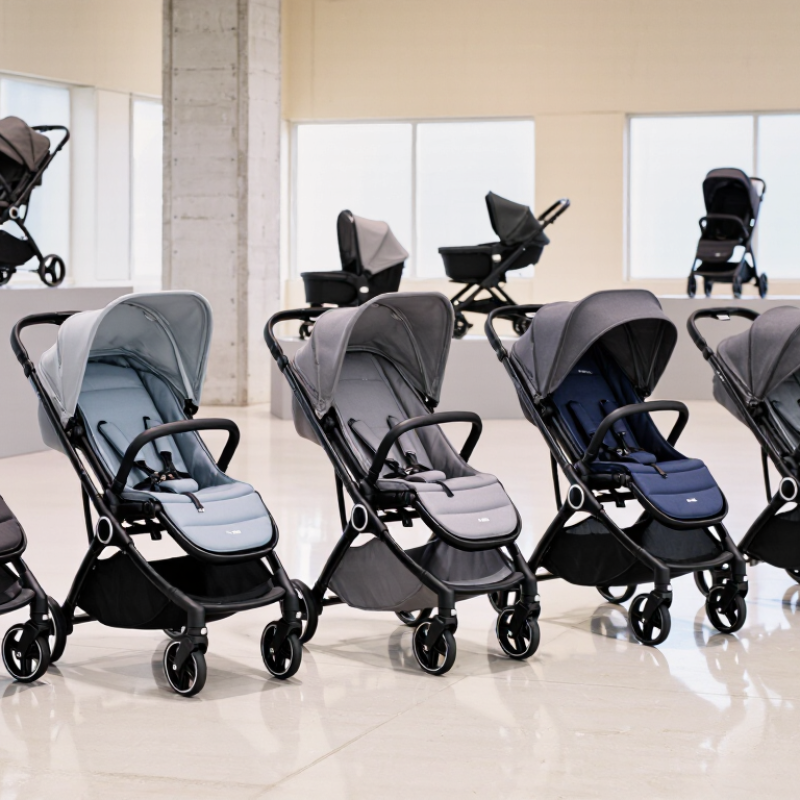
An umbrella folding pram is defined less by its name than by its compact, elongated fold. Its frame usually closes into a slim shape, making it easier to carry on stairs or store beside a hallway wall. Many models use two separate handles and small wheels, which suit short trips on smooth pavements. Small, but not simple. A lighter frame can make lifting easier, yet may feel less steady over uneven ground. That trade-off is easy to underestimate.
Practical design also means checking the harness, brakes, folding lock, and seat support—not just the folded size. The European EN 1888 stroller safety standard covers requirements and test methods for wheeled child conveyances; buyers can use it as a useful technical reference. Grand View Research’s Global Baby Stroller Market report estimated the market at USD 2.7 billion in 2023 and projected a 5.3% compound annual growth rate from 2024 to 2030. This market figure describes category demand, not product safety or quality. A clear product specification matters more: folded dimensions, product weight, child-weight limit, and whether the pram can stand securely when folded. Even then, published numbers do not tell the whole story. A narrow doorway or a bumpy curb can change what “easy to use” means.

China’s umbrella pram manufacturing landscape is built around compact design and coordinated component production. A typical model combines a folding frame, seat fabric, canopy, wheels, brakes, and harness. These parts may come from different workshops, so clear specifications matter. A few millimeters can affect how smoothly the frame locks or fits into a car trunk.
Manufacturers often compete on weight, folding speed, durability, and production consistency. Buyers should examine more than a product sample. Check hinge movement, wheel alignment, stitching, brake response, and whether the folded pram stays closed during handling. Ask how factories inspect incoming materials and finished units. Records from repeated production runs can reveal more than one polished demonstration. Small details count.
The landscape also has trade-offs. Lighter frames are easier to carry, but may feel less steady on uneven pavement. A broad canopy offers useful shade, yet can make the folded package bulkier. Supplier capability varies, and a neat sample does not guarantee identical results at scale. That is worth remembering. Buyers benefit from discussing intended use, packaging, spare parts, and quality checks before confirming an order. One overlooked point is repairability: a simple, replaceable wheel can matter more than an extra feature.
Annual births in China provide demographic context for the domestic market for prams and other infant products.
Births declined from 17.86 million in 2016 to 9.54 million in 2024, with a modest increase in 2024. These figures indicate demographic context only; they do not represent pram production, sales, or manufacturer counts. Source: National Bureau of Statistics of China, annual statistical communiqués.
Selecting the top 10 umbrella folding pram manufacturers calls for clear, practical criteria—not polished catalog photos alone. Check whether each factory can explain its frame materials, fabric specifications, quality checks, and production capacity. Ask for a sample and fold it repeatedly. Look for loose joints, uneven stitching, wheels that wobble, or a canopy that slips out of position. Small flaws matter.
Safety and usability should carry significant weight. Review the restraint system, brake response, folding lock, handle comfort, and stability on different surfaces. Ask how the manufacturer tests these parts and whether test records are available. Compare sample measurements and product weights against the stated specifications. Reliable suppliers should answer technical questions directly and provide consistent documentation. Delivery history, defect handling, and communication matter, too. A low quote means little if replacement parts arrive late.
Tips: Request a written inspection checklist and compare the same sample details across suppliers. Keep notes on every reply. No scoring method is perfect; a promising factory may still need closer review before selection.
| No. | Evaluation Criterion | Weight | Evidence to Request | Recommended Screening Benchmark |
|---|---|---|---|---|
| 1 | Applicable product safety compliance | 18% | Current test reports for the exact pram model and intended sales market; report scope, model identification, and laboratory details. | Reports should address the applicable requirements, such as EN 1888-1 for wheeled child conveyances in relevant markets or ASTM F833 in the United States. Confirm the applicable edition and local requirements. |
| 2 | Independent testing and corrective action | 15% | Third-party laboratory reports, failed-test records where applicable, corrective-action documentation, and evidence of retesting. | Reports should be traceable to the offered model and reflect the final production configuration, not merely a similar sample. |
| 3 | Frame strength and durability | 10% | Frame material and construction specifications, load and durability test results, weld or joint inspection records. | Check that the frame remains stable and functional after the relevant standard’s structural and repeated-use tests. |
| 4 | Folding mechanism and locking system | 10% | Fold-cycle test records, lock engagement checks, operating instructions, and inspection criteria for folding joints. | The pram should fold and unfold consistently, with its locking system engaging reliably during repeated operation. |
| 5 | Harness and child restraint | 10% | Harness design details, buckle operation checks, restraint testing, and user instructions. | Verify that the restraint system meets the applicable product standard and can be adjusted and fastened as instructed. |
| 6 | Wheels, steering, and brakes | 8% | Wheel and brake specifications, brake-hold test results, and checks for wheel retention and smooth operation. | Confirm that brakes hold as required by the applicable standard and that wheels remain securely attached during use. |
| 7 | Canopy and fabric performance | 7% | Fabric composition, colorfastness and care information, seam inspection, and any substantiated UV-performance claims. | Request test evidence for advertised fabric claims; do not treat a canopy as a substitute for appropriate sun protection. |
| 8 | Material and chemical documentation | 7% | Material declarations and market-specific chemical compliance documentation, including relevant restricted-substance testing. | Check requirements for the destination market, such as applicable CPSIA provisions in the United States or REACH restrictions in the European Union. |
| 9 | Quality control and traceability | 8% | Incoming, in-process, and final inspection records; batch or lot identification; complaint handling and product-change controls. | A documented quality management system, such as one based on ISO 9001, can support process control but does not replace product safety testing. |
| 10 | Capacity, age guidance, and instructions | 7% | Declared child weight and age limits, warnings, assembly and use instructions, and consistency between labeling and test documentation. | The stated limits must be supported by the tested design and clearly communicated for the intended market. |
| Total weighting | 100% | Use the same criteria and evidence requirements when comparing shortlisted manufacturers. | ||
Note: These are screening criteria, not claims about any specific manufacturer. Applicable standards and legal requirements depend on the destination market, product configuration, and current regulation.
China’s umbrella-folding-pram suppliers differ in frame design, production scale, and quality-control depth. Grand View Research estimated the global baby stroller market at USD 2.8 billion in 2023, with projected annual growth of 5.3% through 2030. This covers strollers broadly, not umbrella models alone. The profiles below describe supplier capabilities, not a verified ranking; public data rarely confirms factory league tables. Profile 1 focuses on lightweight aluminum frames. Profile 2 emphasizes compact folds for small storage spaces. Profile 3 offers broad fabric and canopy options.
Profile 4 specializes in high-volume production, where consistent hinge alignment matters. Profile 5 develops reinforced frames for frequent daily use. Profile 6 combines prams with coordinated accessories. Profile 7 concentrates on export-oriented customization and packaging. Profile 8 prioritizes fabric stitching and canopy coverage. Profile 9 offers flexible production runs for smaller orders. Profile 10 integrates frame assembly and final inspection in one facility. These distinctions are starting points, not proof of performance.
A sample review should include folded dimensions, loaded wheel tests, brake checks, and repeated folding trials. Ask for dated inspection records and clarify which components are made in-house. A neat sample can hide inconsistent batch quality. Supplier profiles should therefore be checked against factory visits, traceable test documents, and recent production samples. One limitation remains: public market reports rarely separate umbrella-folding prams from other stroller types.
Comparing umbrella folding prams takes more than checking folded dimensions and retail photos. Compare frame weight, wheel size, canopy coverage, and how easily the pram locks open. A compact frame is useful on crowded trains, but a narrow seat may feel cramped during longer outings. Small details matter. Check buckle adjustment, brake access, pinch-point protection, and stability on uneven surfaces. Ask suppliers for current test reports and clear information about the safety standards relevant to your sales market. Documents should match the specific model, not just a similar product.
Tips: Request a working sample. Fold it one-handed, test the brake, and inspect stitching around the harness. Ask for written details on inspection steps, sample approval, production lead times, and replacement parts. Ask for evidence.
Manufacturing services can include fabric and color choices, logo application, packaging, and custom specifications. Compare minimum order quantities and confirm whether changes affect tooling, price, or delivery dates. I would not assume that a polished sample guarantees consistent bulk production; that detail deserves follow-up. Request photos or inspection records from actual production runs, and agree on measurable acceptance criteria before ordering. A supplier’s communication is part of the comparison, too. Clear answers help, though response speed alone cannot prove product quality.
©2024 Pine Vista LLC, DBA Design Manufacturing Group. All Rights Reserved.


©2024 Pine Vista LLC, DBA Design Manufacturing Group. All Rights Reserved.
