

Choosing Grain FIBC Bags in 2026 requires more than comparing prices, sizes, and printed specifications. A suitable bag must protect grain during filling, storage, transport, and discharge. It should also match the grain type, moisture level, filling equipment, and expected stacking conditions. A bag that performs well in a dry warehouse may fail during humid export handling.
Packaging consultant David J. Newman explains, “A reliable bulk bag begins with the grain, not the catalog.” This practical view remains important. Buyers should check fabric strength, safe working load, safety factor, liner compatibility, seam quality, and lifting-loop design. Food-contact requirements also deserve careful review. Small details matter. A loose liner can trap moisture. Weak seams can stretch under uneven loading. Poorly designed loops can complicate forklift handling.
The best Grain FIBC Bags are selected through documented requirements and real operating experience. Review supplier test reports, production controls, traceability procedures, and previous performance with similar grains. Ask how the bags behave after long storage, repeated movement, and exposure to temperature changes. Do not rely on attractive photographs alone.
There is no universal “best” bag. That assumption often causes costly mistakes. Some buyers also overlook discharge speed and dust control until the first unloading cycle. In 2026, responsible selection should balance safety, cleanliness, durability, sustainability, and total handling cost. This guide examines those factors closely, while recognizing that site conditions can challenge even a well-designed packaging solution.
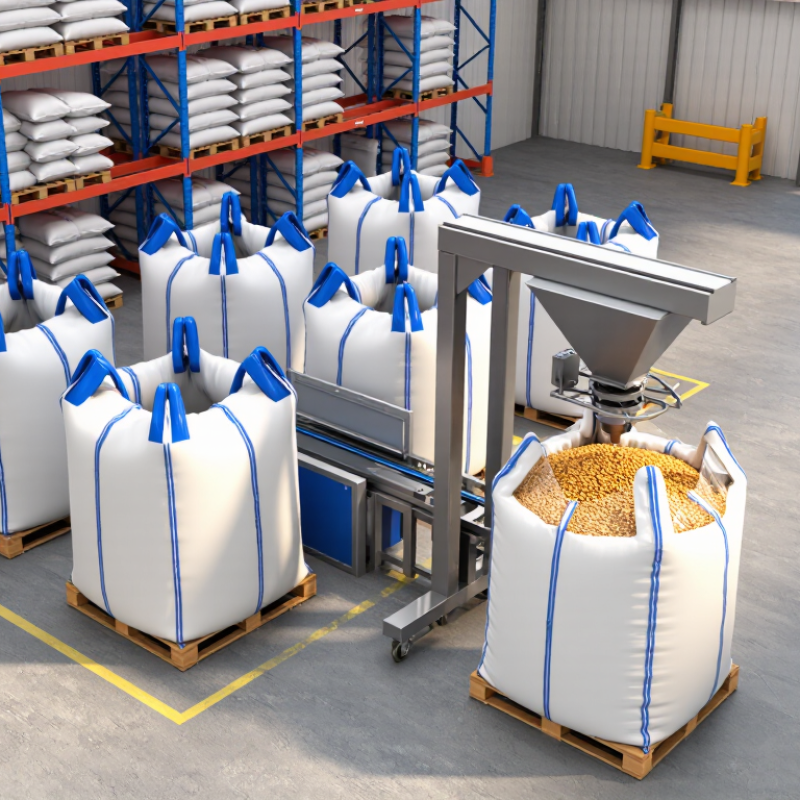
How to Choose Grain FIBC Bags in 2026?
Grain FIBC bags are flexible bulk containers made mainly from woven polypropylene. Their design must match the grain, filling method, storage time, and handling equipment. Common types include circular, U-panel, and four-panel bags. Baffle bags keep a squarer shape and use warehouse space efficiently. They are practical, but not always necessary.
Uncoated fabric allows better air movement in dry conditions. Coated polypropylene offers stronger protection against surface moisture and dust. A food-grade polyethylene liner can provide an additional barrier for sensitive grain. Ventilated fabric may help release heat, yet it cannot replace controlled storage. For humid environments, selecting only by fabric price is a weak decision.
Construction details deserve close inspection. Check the safe working load, safety factor, lifting loops, seam strength, and discharge spout design. A flat bottom supports stable stacking, while a bottom outlet can reduce manual handling. The filling opening should fit the loading system without forcing the bag’s seams. I would also request production samples and test reports before ordering large quantities. Specifications can look convincing on paper. Real handling sometimes reveals awkward loops, slow discharge, or unexpected dust leakage. Local food-contact and transport requirements should be verified with a qualified inspector.

How to Choose Grain FIBC Bags in 2026?
Match Bag Capacity and Design to Grain Handling Requirements
Choosing grain FIBC bags in 2026 starts with the handling route, not the printed capacity. A bag for a small auger may need different features than one lifted by a forklift. Record grain type, bulk density, filling rate, discharge method, and storage period. Then match the safe working load with a practical margin. Do not fill to the rated limit every time. That habit leaves little room for moisture, uneven loading, or operator error. Do not guess.
For dense wheat, corn, or rice, a 1,000-kilogram bag can be efficient. However, the lifting equipment must support that load safely. Confirm pallet dimensions, hopper height, lifting-loop spacing, and warehouse clearance. A four-loop design suits many standard lifting tasks. Another loop arrangement may improve control during mechanical handling. Choose a filling spout that connects cleanly to the conveyor. Dust leakage wastes product and clouds the work area. A discharge spout should open steadily under grain pressure. Test whether the outlet collapses, clogs, or releases too quickly.
Fabric weight, coating, seams, and liner choice should follow exposure conditions. Dry indoor storage may need less protection than humid transport or outdoor staging. Ask for test records, traceable batch details, and inspection guidance. A sample trial often reveals more than a polished specification sheet. We once assumed a larger bag would save labor. The wider base slowed pallet movement instead. That mistake changed our evaluation checklist. Measure cycle time, damaged bags, and residual grain after discharge. Record those results before approving a full purchase.
Match bag capacity and design to grain bulk density and handling requirements.
For a 1.5 m³ bag, the filled mass is estimated from bulk density. Select a rated SWL above the calculated mass and allow for moisture and handling conditions.
Use filling and discharge options that match the process: open or duffle top for flexible loading, and a discharge spout for controlled unloading.
Confirm the required safety factor, lifting-loop configuration, liner needs, moisture protection and compatibility with forklifts or automated equipment.
Indicative bulk-density ranges are commonly used for planning: wheat 750–850 kg/m³, maize 680–780 kg/m³, milled rice 720–780 kg/m³, soybeans 700–750 kg/m³ and barley 600–680 kg/m³. Actual values vary with moisture, variety, cleaning and compaction.
Food safety should guide every FIBC decision, not only the purchase price. Choose bags made from traceable, food-contact materials with documented cleaning controls. Ask for production records, migration declarations, and batch identification.
Codex General Principles of Food Hygiene, revised in 2022, emphasizes hygienic design, hazard control, and traceability.
Moisture travels. Select woven fabric with suitable coating or a food-grade inner liner. The correct choice depends on grain type, storage time, climate, and filling temperature.
USDA grain inspection guidance treats moisture as a critical quality factor, but limits vary by commodity. Do not copy a moisture specification from another crop. That shortcut can create hidden spoilage.
FAO’s 2023 SDG data reports that 13.2% of food is lost globally between harvest and retail, showing why storage protection deserves serious attention.
Contamination protection requires more than a clean-looking bag. Specify sift-proof seams, sealed discharge outlets, covered filling inlets, and protection against dust, insects, and condensation.
Bags should be stored off the floor and covered from rain and direct sunlight. ISO 21898 provides a useful framework for testing flexible intermediate bulk containers, including lifting and handling performance.
In practice, I would also inspect liner folds and outlet closures by hand. Paperwork can pass. A loose thread can still matter.
How to Choose Grain FIBC Bags in 2026?
A grain FIBC bag must match the real load, not an estimated number. Check its safe working load, lifting method, filling weight, and stacking conditions. A 1,000-kilogram rating may not suit repeated handling or outdoor storage. Confirm the safety factor and test method in the technical file. Ask for proof, not only printed labels.
Certification standards deserve equal attention. For grain applications, request documentation for food-contact materials, migration testing, and manufacturing controls. ISO 21898 can help assess FIBC design and performance. However, one certificate does not cover every market or grain type. Check local import and food-safety requirements before ordering. A clean-looking bag is not evidence of compliance.
Supplier quality appears in small details. Review batch traceability, fabric weight, seam strength, lifting loops, and liner fit. Request recent test reports and a production sample. During inspection, look for uneven stitching, dust inside the bag, weak corners, or damp packaging. These defects are easy to miss under warehouse lighting. I have seen buyers focus on price and overlook storage conditions. That choice can become expensive. Still, even careful checks can miss problems, so keep incoming inspections and retain samples from each delivery.
| Selection Factor | Recommended Data or Range | What to Verify | Why It Matters for Grain |
|---|---|---|---|
| Safe Working Load (SWL) | Common grain FIBC ratings are approximately 500–2,000 kg per bag. Select the rating according to the actual product weight, filling equipment, lifting method, and stacking plan. | The SWL must be permanently marked on the bag and supported by a product specification sheet and test documentation. | The rated load helps prevent seam failure, lifting-loop damage, and deformation during handling. Never exceed the marked SWL. |
| Safety Factor and Bag Type | Typical FIBC designs use a 5:1 or 6:1 safety factor. Single-trip bags and reusable bags require different design validation and handling controls. | Check the safety factor, cyclic or reuse testing where applicable, lifting-loop design, and the intended-use statement. | A reusable specification should not be assumed solely because the bag appears strong. Reuse depends on inspection, cleaning, storage, and the manufacturer’s validated design. |
| Grain Bulk Density and Volume | Approximate bulk-density ranges are: wheat 0.75–0.85 t/m³, maize 0.70–0.80 t/m³, and milled rice 0.55–0.75 t/m³. Actual density varies with moisture, variety, and compaction. | Calculate volume from the measured product density and target weight. Confirm bag dimensions, filling height, and usable capacity before ordering. | A bag with sufficient volume may still be overloaded by weight. Both capacity in cubic metres and SWL in kilograms must be checked. |
| Fabric and Construction | Use woven polypropylene fabric with suitable UV stabilization, strong corner seams, and an appropriate top and bottom construction, such as duffle top and spout discharge. | Review fabric weight, seam construction, lifting-loop configuration, UV requirement, and dimensional tolerances in the technical specification. | Construction should match the filling line, forklift or crane handling system, storage duration, and exposure to sunlight or outdoor conditions. |
| Dust Control and Liner Selection | Use a suitable liner or coated fabric when fine grain, flour-like particles, moisture protection, or enhanced product cleanliness is required. Common liner materials include polyethylene films. | Confirm liner material, thickness, fit, seal method, food-contact suitability, and compatibility with the filling and discharge process. | A suitable liner can reduce leakage and contamination risk, but excessive static, trapped moisture, or poor liner fitting can create operational problems. |
| Food-Contact Compliance | For food-grade grain, use materials and production controls suitable for the destination market. Requirements may include EU food-contact rules or applicable U.S. FDA regulations. | Request a declaration of compliance, raw-material information, migration or suitability test results where required, and a statement covering inks, coatings, liners, and sewing materials. | “Food grade” is not a universal certification. Compliance must cover every material that may contact the grain and must match the importing country’s rules. |
| FIBC Standard and Testing | Use FIBCs designed and tested in accordance with ISO 21898 for non-dangerous goods, together with any required electrostatic classification and handling tests. | Check test reports for lifting, toppling, stacking, seam strength, drop, and, where relevant, electrostatic performance. Reports should identify the tested construction and batch or model. | A standard reference provides a structured basis for evaluating mechanical performance, but it does not replace a risk assessment for the specific grain-handling system. |
| Electrostatic Risk | For ordinary grain in non-hazardous environments, select the electrostatic class according to the process risk. Type A, B, C, or D FIBC classifications may be relevant where dust clouds, solvents, or explosive atmospheres are present. | Obtain an electrostatic classification and test report to IEC 61340-4-4 or the applicable local requirement. Verify grounding procedures for conductive Type C bags. | Grain dust can be combustible. Static-control requirements depend on dust concentration, equipment, atmosphere, and the complete handling process—not only the bag. |
| Moisture and Storage Protection | Choose coated fabric or a liner when protection from rain, humidity, or short-term condensation is required. FIBCs are not automatically waterproof. | Confirm coating or liner performance, closure design, moisture-barrier requirements, and recommended storage conditions. | Moisture can promote mold growth, caking, quality loss, and increased product weight. Store filled bags on a clean, dry surface away from water and direct sunlight. |
| Supplier Quality System | Prefer suppliers with documented incoming-material controls, production inspection, batch traceability, nonconformance procedures, and controlled technical specifications. | Request a sample approval process, certificate of analysis or conformity, batch records, inspection results, and recent independent or internal test reports. | Consistent raw materials and traceability reduce variation in SWL, dimensions, seam strength, cleanliness, and food-contact performance. |
| Cleanliness and Contamination Control | For grain intended for human or animal consumption, specify a clean manufacturing area, controlled packaging, and protection from oil, dust, foreign fibers, pests, and previous cargo residues. | Check cleaning procedures, pest-control records, packaging method, production-area controls, and declarations regarding previous use. | A mechanically strong bag can still be unsuitable if it introduces foreign matter, odors, allergens, or chemical contamination. |
| Sampling and Acceptance Criteria | Approve a production sample before mass delivery. Define acceptable limits for dimensions, fabric appearance, stitching, loop position, liner fit, printing, and cleanliness. | Use an agreed inspection plan with measurable tolerances and retain reference samples from approved production batches. | Pre-shipment sampling helps identify problems that may not be visible from certificates alone, especially with filling-machine fit and discharge performance. |
Important: Final selection should be based on the actual grain density, target fill weight, filling and discharge equipment, storage environment, food-contact requirements, and site-specific dust and static-risk assessment. Certification and regulatory requirements vary by destination market.
How to Choose Grain FIBC Bags in 2026?
Cost should be measured beyond the purchase invoice. A low-priced FIBC may need stronger handling controls, liners, or earlier replacement. Compare safe working load, fabric weight, discharge design, and transport efficiency. My first cost comparison was too simple. I ignored labor time during filling and emptying. That mistake changed the final estimate.
Reusability can reduce waste, but it is not automatic. Inspect each bag for torn seams, damaged lifting loops, stains, and moisture exposure. Reuse only when its construction remains suitable for the grain and handling cycle. A clean, documented inspection process improves reliability. Still, repeated folding can weaken fabric. That detail is easy to miss. Store empty bags indoors, away from sunlight, rodents, sharp edges, and damp floors. Use pallets or raised platforms. Do not place them directly against wet walls.
Storage capacity also affects cost. FIBC bags use less floor space than rigid containers, but unstable stacks create safety problems. Keep stack heights conservative and follow the manufacturer’s loading guidance. Grain density changes pressure inside the bag. Disposal requires equal care. Separate removable liners, cords, and contaminated materials where facilities allow. Clean, uncontaminated polypropylene may enter suitable recycling streams, while damaged or soiled bags may require controlled waste handling. Local disposal rules differ, so confirm them before shipment or disposal.
©2024 Pine Vista LLC, DBA Design Manufacturing Group. All Rights Reserved.


©2024 Pine Vista LLC, DBA Design Manufacturing Group. All Rights Reserved.
