

China Top Granite Tri Square Ruler Manufacturers?

China has become a significant sourcing region for precision granite inspection tools, including the granite tri-square ruler. This guide examines manufacturers that serve metrology laboratories, machining plants, and quality-control departments. It focuses on practical evidence, not attractive catalog language alone. A reliable supplier should explain granite grade, squareness tolerance, surface flatness, edge finishing, and inspection methods clearly.

Manufacturing details matter. Experienced factories usually combine diamond grinding, hand lapping, controlled cleaning, and final verification. Some use coordinate measuring machines or optical equipment to check perpendicularity. Others provide inspection reports linked to calibrated reference standards. These documents help buyers compare performance across different production batches. The best manufacturers also discuss packaging, moisture protection, lifting points, and replacement policies before an order is placed.

Not every supplier communicates equally well. That matters.

A strong evaluation should consider factory experience, engineering support, customization capability, and after-sales responsiveness. Buyers may need metric or imperial graduations, special lengths, threaded inserts, or protective cases. Material consistency is equally important because small structural differences can affect long-term stability. Product photographs can help, but they cannot replace dimensional reports or sample inspections. In some cases, supplier claims remain difficult to verify remotely. That is a limitation worth acknowledging.

This overview will help readers compare China’s leading granite tri-square ruler manufacturers through measurable criteria. It will consider technical competence, quality systems, production capacity, delivery reliability, and customer feedback. The aim is not to name a winner too quickly. It is to identify suppliers that can provide dependable accuracy, transparent documentation, and practical support for demanding inspection work.
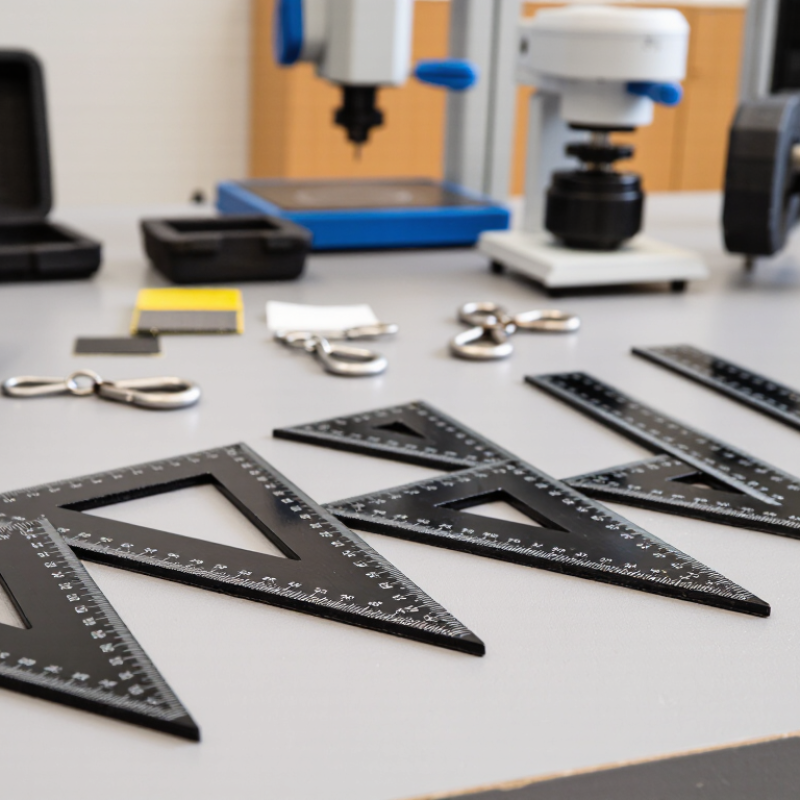
China Top Granite Tri Square Ruler Manufacturers?

What Is a Granite Tri Square Ruler?

A granite tri square ruler is a precision inspection tool for checking 90-degree angles. It usually has a granite base and a vertical granite blade. The blade rests firmly against the base, forming a dependable right angle. Unlike ordinary metal rulers, it resists rust, vibration, and moderate temperature changes. Its dark, smooth surface also makes scratches and dust easier to notice.

In practical workshops, inspectors place the base on a cleaned surface plate. They then compare the upright blade with a machined component, gauge block, or reference edge. High-quality tools are carefully lapped and checked for flatness, squareness, and stability. Clear graduations can help with basic measurement, but they do not replace certified inspection equipment. Terminology can vary; some suppliers call this tool a granite try square. That difference deserves attention when comparing specifications.

Tips: Wipe the granite before every inspection. Use lint-free cloths and avoid dragging metal parts across the surface. Store the square on a stable shelf, not near heat sources. Check calibration at planned intervals. Even experienced users can overlook a thin dust layer. I have found that handling pressure also affects readings, so repeat doubtful checks gently. A perfect-looking edge may still need professional verification.

Key Standards for Evaluating Chinese Manufacturers

China Top Granite Tri Square Ruler Manufacturers?

Key Standards for Evaluating Chinese Manufacturers

Choosing a Chinese granite tri square ruler manufacturer requires more than comparing prices. Examine granite quality, dimensional accuracy, and inspection discipline. The stone should have stable mineral structure, fine grain, and low porosity. Black granite is common, but color alone proves little.

Ask for flatness, squareness, parallelism, and surface roughness results for each size. The report should show measurement equipment, inspection dates, tolerances, and measurement uncertainty. Calibration should be traceable to recognized national or international standards. An ISO/IEC 17025-accredited laboratory adds useful confidence, especially for precision orders. Request the applicable standard, such as DIN 876 where relevant, and confirm how the factory interprets its grades.

Look closely at the working edges. They should be smooth, sharp, and free from chips, pits, or polishing waves. A practical factory should provide a sample inspection sheet and clear acceptance criteria before production. Packaging also matters. Thick foam, corner protection, moisture control, and a rigid wooden crate can prevent hidden damage during shipping. Ask whether operators check temperature before measurement, because granite changes slightly with heat. Small details matter.

A factory audit can reveal more than a sales presentation. Check dedicated inspection areas, granite storage conditions, and records for rejected pieces. No supplier is perfect. I have seen accurate products accompanied by incomplete documentation. That gap deserves attention, not assumptions. Request a trial order, verify the delivered ruler independently, and compare its actual readings with the promised tolerance.

Manufacturing Process and Quality Control

Manufacturing a granite tri square ruler begins with dense, low-porosity stone selection. Black granite is cut oversized, then stress-relieved before precision machining. This waiting period matters. Hidden movement can appear later.

CNC milling creates the reference faces and inner corner. Diamond tools remove material in controlled passes. Skilled operators then lap each surface with calibrated abrasives. The target is not visual shine alone. Flatness, straightness, and squareness require measurement at 20°C, the reference temperature specified by ISO 1:2016. Granite typically expands by about 5–8 μm per meter for a 1°C change, depending on its grade. A small workshop temperature shift can affect a large ruler.

Quality control should include traceable granite masters, electronic levels, autocollimators, and coordinate measuring equipment. Inspectors check the 90-degree relationship at several points, not only near the corner. Calibration records should identify equipment, uncertainty, operator, and test temperature. The ISO Survey 2022 reported 1,265,216 ISO 9001 certificates across 189 countries and economies, showing the scale of formal quality systems. Certification alone proves little, however. A supplier must provide actual inspection results. Our process is not flawless; occasional re-lapping may be necessary when stone movement appears after machining. That weakness deserves documentation, not concealment.

Leading Manufacturer Profiles and Product Capabilities

China Top Granite Tri Square Ruler Manufacturers?

Leading Manufacturer Profiles and Product Capabilities

China’s granite tri square ruler manufacturers generally serve precision machining, inspection, and metrology workshops. Experienced suppliers usually explain granite grades, squareness tolerances, surface flatness, and edge finishing clearly. Their product profiles may include cast iron alternatives, black granite models, and custom inspection squares. Granite remains popular because it resists corrosion, absorbs little heat, and maintains stable geometry.

Reliable factories often use CNC grinding, controlled polishing, and coordinate measuring equipment. A capable production team checks each ruler against calibrated reference standards. Quality records should identify material batch, inspection date, measured deviation, and operator approval. Some manufacturers provide protective cases, lifting holes, threaded inserts, or engraved scales. These details matter during daily handling.

Small differences matter.

A serious supplier also discusses packaging and delivery risks. Thick foam, sealed wrapping, and reinforced wooden crates help protect fragile edges. Technical drawings should confirm dimensions before production begins. Custom orders may require extra review, especially for large sizes or unusual mounting points. No manufacturer is flawless. Occasional delays, surface marks, or communication gaps can appear, so buyers should request sample reports and clarify correction procedures. Factory visits, video inspections, and independent measurement can provide stronger evidence than catalog claims.

How to Select the Right Chinese Supplier

China Top Granite Tri Square Ruler Manufacturers?

How to Select the Right Chinese Supplier

Selecting a Chinese granite tri square ruler supplier requires more than comparing prices. Check the granite grade, surface finish, squareness, and measuring tolerance. Ask for inspection records from a calibrated coordinate measuring machine or precision inspection equipment. A reliable supplier should explain its testing method clearly.

Request a sample before placing a large order. Inspect its straight edges under controlled lighting. Check for chips, uneven polishing, stains, and unstable contact points. Ask whether the ruler includes a calibration certificate, protective case, and traceable serial number. Packaging also matters. Thick foam, sealed wrapping, and a reinforced wooden crate can prevent damage during long transport.

Review the supplier’s production experience and quality system. Factory photos help, but an online meeting or independent factory audit provides stronger evidence. Confirm granite origin, machining capability, lead time, replacement terms, and export documentation. Communication speed is useful, but technical answers matter more. A low quotation can hide weak calibration or expensive rework. That lesson is easy to miss. Even a good sample cannot prove consistent batch quality. Compare several samples when accuracy is critical, and record every agreed tolerance in the purchase contract. Supplier selection is not perfect science. Careful verification simply reduces unpleasant surprises.

China Top Granite Tri Square Ruler Manufacturers? - How to Select the Right Chinese Supplier

The table below provides practical, supplier-neutral benchmarks for evaluating Chinese manufacturers of granite tri-square rulers. Figures marked as “typical” are indicative purchasing ranges and should be confirmed by written quotations, drawings, and inspection reports.

Evaluation Dimension Recommended Requirement Typical Reference Data Verification Method
Granite Material Use stable, fine-grained black granite with low porosity and consistent density. Typical density: approximately 2.6–2.8 g/cm³; water absorption is commonly below 0.5% for suitable precision granite. Request the material specification, density data, water-absorption test, and a sample surface inspection.
Square Geometry The blade and base should be machined as an integrated precision reference tool, with a clearly defined squareness tolerance. Common product specifications include 90° squareness tolerances from approximately 2–10 μm, depending on size and accuracy grade. Ask for a dimensional drawing, tolerance grade, calibration method, and inspection certificate for the finished tool.
Flatness The reference faces should be lapped or precision-ground and free from visible chips, distortion, and high spots. Typical flatness tolerances range from about 2–10 μm for small and medium precision granite tools; larger tools may require a different tolerance. Confirm the specified measuring area, tolerance zone, measurement equipment, and calibration status.
Surface Finish Working faces should have a uniform, low-reflective precision finish without pits, cracks, resin marks, or uneven polishing. A fine lapped finish is generally preferred for stable contact and repeatable measurement rather than a decorative polished finish. Inspect samples under angled light and check contact behavior with a certified reference surface.
Available Sizes Select dimensions according to the workpiece size, required reach, storage space, and handling capability. Common blade heights are approximately 100–500 mm; custom sizes may be available for larger inspection applications. Review a dimensioned drawing showing overall height, base length, thickness, working faces, and corner radii.
Dimensional Stability The granite should be stress-relieved or properly aged before precision machining to reduce long-term movement. Granite has low thermal expansion compared with many metals, but temperature changes can still affect measurement results. Ask about quarry source, material aging, temperature conditioning, and recommended operating conditions.
Inspection and Calibration Every production batch should be inspected against documented tolerances before shipment. A complete report should normally include squareness, flatness, dimensions, visual condition, and inspection date. Require a signed inspection report, calibration traceability, equipment details, and an agreed acceptance standard.
Quality Management Prefer a documented quality system with controlled drawings, incoming inspection, process records, and corrective-action procedures. ISO 9001 certification can support process control, but it does not by itself prove the accuracy of a specific ruler. Check the certificate validity, certification scope, audit status, and actual production records.
Customization Capability The supplier should be able to produce custom dimensions, tolerance grades, mounting holes, inserts, or identification marks when required. Custom tooling commonly requires an approved drawing and may involve sample or setup charges. Use a signed technical drawing with revision control, tolerances, material requirements, and acceptance criteria.
Packaging Protection Use shock-absorbing protection, moisture control, corner protection, and a rigid export crate suitable for the tool’s weight. Granite is hard but brittle; impacts can cause edge damage even when the main body appears undamaged. Request packaging photographs, crate dimensions, gross weight, lifting instructions, and a drop-risk assessment.
Typical Production Lead Time Lead time should include material preparation, machining, inspection, packing, and export documentation. Standard items often require approximately 2–5 weeks; custom precision items may require 4–8 weeks or more. Obtain a written schedule with sample approval, production completion, inspection, and shipment milestones.
Minimum Order Quantity Choose a supplier willing to support the required order quantity without compromising inspection or packaging quality. Precision granite tools are often quoted per piece; custom projects may have minimum quantities or setup fees. Request separate pricing for one sample, a small batch, and the expected annual volume.
Commercial Terms The quotation should clearly state product price, tooling, packaging, inspection, freight, taxes, payment terms, and delivery terms. International quotations may use Incoterms such as EXW, FOB, CIF, or DAP; the included services differ significantly. Compare quotations on the same specification and Incoterm rather than comparing unit price alone.
Supplier Communication Technical questions should receive clear, consistent answers supported by drawings, photos, reports, and corrective-action records. A reliable supplier should be able to explain tolerances, inspection methods, packaging risks, and nonconformance handling. Use a written questionnaire and score response accuracy, response time, documentation quality, and engineering support.
Recommended Selection Weight Prioritize accuracy and quality control over the lowest quoted price. Suggested scoring: technical accuracy 30%, quality system 20%, inspection evidence 15%, material and finish 10%, delivery 10%, packaging 5%, commercial terms 10%. Score at least three qualified suppliers using the same specification, sample process, and acceptance criteria.

Final acceptance should be based on the approved technical drawing, agreed tolerances, inspection documentation, and a pre-shipment or arrival inspection—not on catalog descriptions alone.

Article Source:

137 Seacoast Ave, New York, NY 10094
+1 (234) 466-9764
Excuisite food, unforgettable atmosphere...