

Choosing kitchenware for a growing brand involves more than selecting a shape or color. A custom kitchenware manufacturer can help turn a product idea into practical specifications, prototypes, and repeatable production. That support matters when a handle must feel comfortable, a lid must fit securely, or a finish must withstand regular washing. Small details show up quickly in daily use.
A capable manufacturing partner should explain material options, production limits, quality checks, and expected lead times in clear terms. Ask how samples are reviewed and how defects are recorded. Request relevant test reports, and confirm that products meet the requirements of the markets where they will be sold. Standards vary, so assumptions are risky. Details matter.
Customization can also involve trade-offs. A complex shape may require extra tooling, while a special coating could affect cost or delivery time. Early samples help reveal these issues before a larger order is placed, though a sample cannot guarantee every production run will be identical. That deserves attention.
The right partner is not simply the one offering the most choices. Look for evidence of consistent communication, documented quality processes, and experience with similar products. Share clear drawings, use cases, and target quantities, then ask specific questions about what can be improved. A thoughtful manufacturer can guide those decisions, but your team still needs to review the product carefully. Not every idea works. The goal is useful kitchenware that looks right, performs reliably, and makes sense to produce.
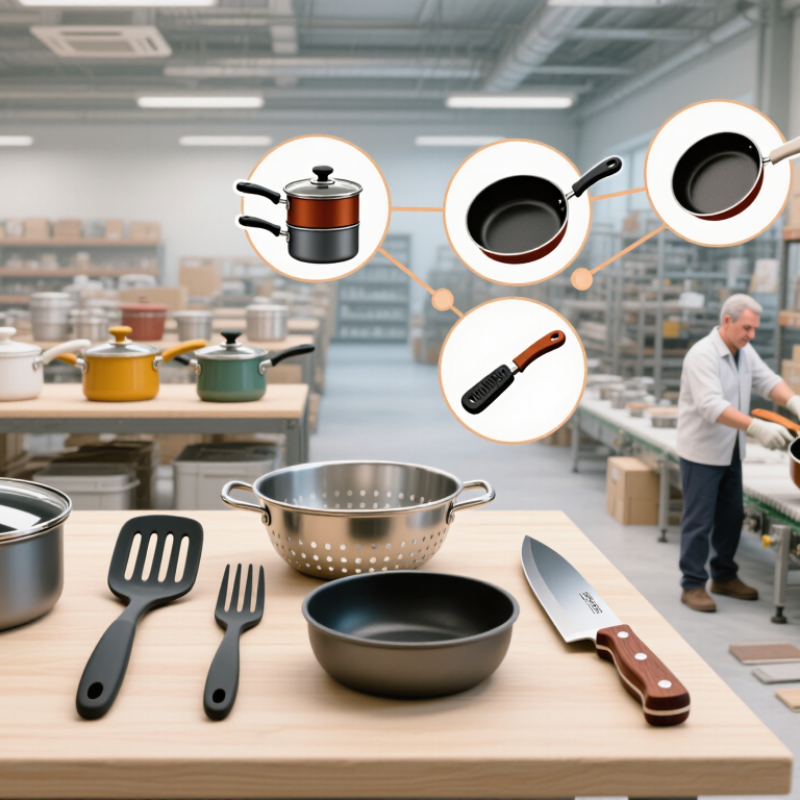
A custom kitchenware manufacturer does more than place a logo on a standard pan or utensil. It can adjust dimensions, materials, handle shapes, finishes, packaging, and production volumes to match a buyer’s needs. Its work often starts with a design brief, then moves through samples, tooling, production, and quality checks. A useful manufacturer explains what can be changed and what cannot. For example, a thicker pan base may improve heat distribution, but it can also add weight and cost.
Customization is only meaningful when specifications are measurable. Ask how the maker checks dimensions, surface quality, and consistency between samples and finished batches. Request material documentation and test records relevant to the intended use.
Deloitte’s 2015 report Made-to-order: The Rise of Mass Personalization found that 36% of surveyed consumers were interested in personalized products, while one in five would consider paying more for them. This is broad consumer research, not kitchenware-specific evidence, but it signals why tailored products attract attention.
Details matter. A handle that feels comfortable in a sample may feel different after hours of use. Even a clear brief can miss something; early user testing helps expose those gaps before full production.

A custom kitchenware project begins with a clear account of how the item will be used. A mixing bowl for a home cook needs different proportions from one used on a busy prep line. Designers consider grip, capacity, storage, cleaning, and the space available in a dishwasher or cupboard. Small details matter. A handle that feels comfortable when empty may become awkward when the vessel is full.
Material choice shapes both performance and production. Stainless steel, food-grade plastics, and ceramics behave differently under heat, impact, and repeated washing. The manufacturer reviews the intended use, then develops drawings with dimensions, tolerances, and surface finishes. A prototype makes these choices tangible. It may reveal a rim that feels too sharp or a lid that shifts during pouring. Back to the drawing board. That is normal, though it can add time.
Once the design is approved, production may involve molding, stamping, forming, or firing, depending on the material and shape. Samples are checked for dimensions, finish, fit, and practical handling before larger runs begin. Quality checks should reflect real use, not just appearance: a utensil should sit securely, and a container should remain stable on a counter. Even a careful process has limits. A small change in material or tooling can affect the final feel, so clear specifications and ongoing inspection help keep batches consistent.
Custom kitchenware manufacturing lets teams choose dimensions, materials, finishes, and features around real cooking tasks. A deeper sauté pan can reduce splashes; a handle shaped for a gloved hand may feel steadier during a busy service. Small details count. McKinsey’s 2021 personalization research found that 71% of consumers expect personalized interactions, while 76% feel frustrated when they do not receive them. The study covered consumers broadly, not kitchenware buyers specifically, so it signals a wider expectation rather than a guaranteed sales result.
Customization can also support clearer product differentiation and more deliberate material choices. Deloitte’s report, The Deloitte Consumer Review: Made-to-order, found that one in five surveyed consumers would pay 20% more for a personalized product. That finding is useful, but it dates from 2015 and should not be treated as a current kitchenware forecast. In practice, manufacturers can test prototypes for balance, grip, heat resistance, and cleaning effort before committing to a larger run. Trade-offs remain. Custom tooling may raise costs and extend lead times, while a clever design can prove awkward after repeated washing. A sample pan on a crowded stove often reveals what a drawing misses.
Custom manufacturing lets product designers select materials to suit intended cooking performance. Thermal conductivity is one useful consideration: higher values indicate that heat travels more readily through the material.
Typical approximate thermal conductivity at room temperature, in W/(m·K). Actual values vary by alloy, grade, and product construction. Conductivity is only one factor in choosing kitchenware materials.
Custom kitchenware manufacturers serve more than restaurants. Hotels, caterers, school and hospital kitchens, food processors, and retailers may need different dimensions, materials, and production runs. A hotel banquet line may need deep trays that fit its warming cabinets. A bakery may need shallow sheet pans that cool quickly. Small details matter. Custom products can fit specific workflows, storage spaces, and cleaning routines.
The National Restaurant Association’s 2024 State of the Restaurant Industry projected U.S. restaurant sales of $1.1 trillion that year. It also estimated 15.7 million restaurant jobs. These figures show the scale of foodservice demand, but they do not mean every operator needs bespoke tools. Common custom products include stainless-steel pans, prep bowls, portioning tools, serving trays, and stackable storage containers. Thickness, handle shape, edge finish, and nesting clearance can affect everyday use.
Institutional kitchens and processors often prioritize consistent dimensions, durable surfaces, and easy-to-clean joints. Retailers may focus on coordinated product sets and packaging. Requirements vary by menu, equipment, and washing method, so prototypes and production checks matter. Custom features can add cost without helping staff. That deserves scrutiny. Manufacturers should document material grades, tolerances, and inspection steps, then test samples in real kitchen conditions before large orders.
| Industry | Typical Kitchenware Products | Common Customization Needs | Relevant Materials or Processes |
|---|---|---|---|
| Restaurants and food service | Cookware, food-preparation tools, serving utensils, and storage containers | Commercial-use dimensions, durable finishes, utensil shapes, and coordinated sets | Stainless steel fabrication, aluminum forming, and food-contact-grade plastics |
| Hotels and catering | Serving trays, buffet utensils, beverage accessories, and tabletop items | Custom sizes, coordinated designs, stackable forms, and presentation-focused finishes | Metal stamping, polishing, glass forming, and molded components |
| Retail and private-label programs | Cookware sets, utensils, cutting boards, and kitchen organizers | Product specifications, color options, packaging formats, and assortment planning | Metal forming, injection molding, wood processing, and packaging customization |
| Outdoor cooking and camping | Portable cookware, compact utensils, grill tools, and nesting sets | Lightweight construction, packable designs, heat-resistant handles, and easy-clean surfaces | Anodized aluminum, stainless steel, silicone components, and stamped-metal parts |
| Food manufacturing and meal preparation | Measuring tools, scoops, mixing bowls, portioning tools, and containers | Capacity markings, repeatable dimensions, ergonomic grips, and workflow-specific forms | Stainless steel fabrication, precision molding, and food-safe surface finishing |
| Home and lifestyle products | Bakeware, kitchen tools, storage accessories, and reusable drinkware | Color, shape, grip, storage compatibility, and product-set coordination | Silicone molding, glass production, metal forming, and wood or bamboo processing |
| Institutional kitchens | Large-capacity cookware, food pans, ladles, and preparation equipment | High-volume sizing, reinforced construction, handling requirements, and standardized dimensions | Heavy-gauge stainless steel, welded assemblies, and commercial-grade finishes |
Product specifications, materials, and food-contact compliance requirements should be confirmed for the intended market and use.
When choosing a custom kitchenware manufacturer, start with the product’s actual use. A saucepan handle faces different heat and stress than a storage container lid. Ask which materials are available, how thickness is controlled, and whether the factory can explain its testing process. Specific answers matter. A sample should feel balanced, with edges finished cleanly and moving parts fitting without force. Still, one good sample does not prove every production run will match it.
Check quality controls and request records relevant to your product, such as material specifications and inspection results. Confirm how defects are tracked and what happens when a batch fails inspection.
Clarity helps.
Discuss minimum order quantities, tooling charges, packaging, and realistic lead times before approving a design. Ask who handles changes, too; a revised handle or finish can affect cost and timing.
Communication is easy to underestimate.
If replies are vague during sampling, production updates may be vague as well. Compare the full process, not just the quoted unit price. A lower price can look attractive, but unclear tolerances or weak inspection plans may create costly rework. I would also leave room for a small pilot run, even when the design seems straightforward. It may reveal a detail nobody caught on screen.
©2024 Pine Vista LLC, DBA Design Manufacturing Group. All Rights Reserved.


©2024 Pine Vista LLC, DBA Design Manufacturing Group. All Rights Reserved.
