


A skincare formula can be carefully developed and still disappoint when dispensing feels messy, inconsistent, or unhygienic. A Skincare Pump can help deliver measured doses, limit direct contact with the product, and make daily use simpler. That matters at a bathroom sink, where wet hands and rushed mornings are common. But packaging is part of product performance, not a cure-all.
The market context is substantial. Grand View Research estimated the global cosmetic packaging market at USD 49.4 billion in 2022 and projected growth through 2030 in its Cosmetic Packaging Market Size report. That figure covers many packaging types; it does not measure skincare pumps alone. Still, it signals how much attention brands give to packaging choices. A pump’s value depends on the formula, viscosity, container, and dispensing mechanism working together. A thick cream may need a different design from a light serum. Test the actual product, not only the empty package.
There are trade-offs. Some pumps can leave residue inside, add material complexity, or be difficult to recycle when components cannot be separated. The right choice should balance dose consistency, product protection, user experience, and end-of-life considerations. Small details matter. A nozzle that clogs can quickly erode trust. A well-matched pump may support a better routine, though results depend on sound design and testing.
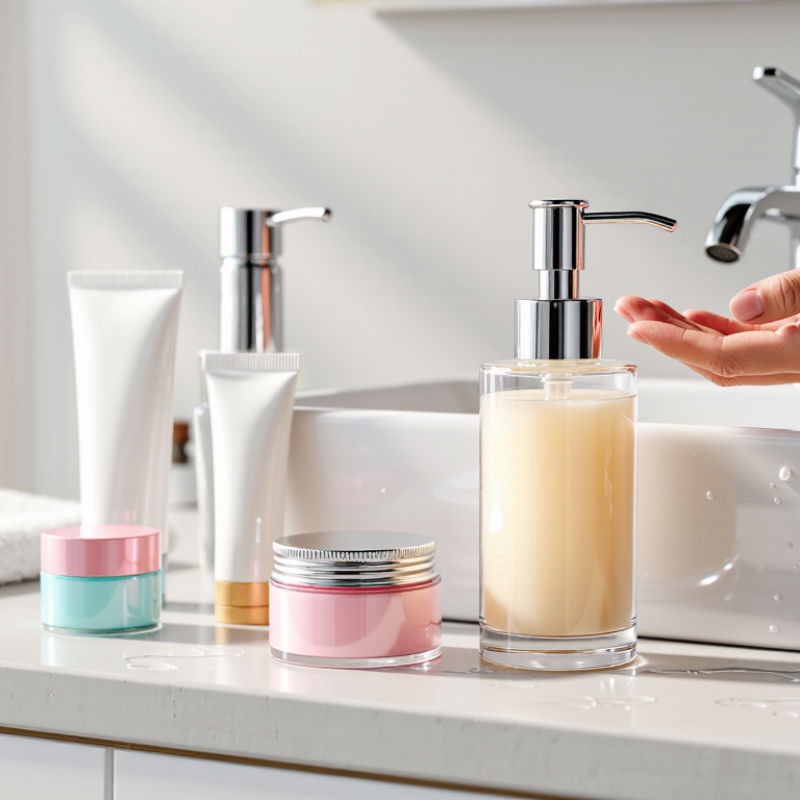
A skincare pump is a closure that dispenses product when you press its actuator. Inside, a small chamber, spring, and one-way valves control the flow. In a common dip-tube design, pressing the top pushes product through the nozzle. Releasing it lets the spring return and draws more product up through a tube from the bottle. One press, one measured dose—though the amount varies by pump and formula.
Airless pumps work differently. A movable base rises as product is dispensed, reducing the air space inside the container. This can help limit the formula’s contact with air, but it does not make the product sterile. A pump may also reduce repeated finger contact compared with an open jar. Still, the nozzle can collect residue. Wipe it clean if product builds up.
The details matter. Thick creams may need a wider passage or stronger actuator, while a watery serum can dispense too quickly. Some pumps need several presses before product reaches the nozzle. That can be frustrating. A pump can also leave a little product behind, especially near the bottle walls. Test the package with the actual formula, not just water; the texture and flow may behave differently.
| Dimension | How It Works | Practical Benefit | What to Consider |
|---|---|---|---|
| What a skincare pump is | A dispensing closure fitted to a container. Pressing its actuator moves product through an internal passage and out of the nozzle. | Provides a controlled way to dispense liquid, lotion, gel, or other compatible formulas. | Pump performance depends on the formula’s viscosity, container, and pump design. |
| Basic pump mechanism | On a typical pump, pressing the actuator drives a piston and dispenses product. Releasing it allows the mechanism to reset and draw more product into the pump chamber. | Repeated presses dispense successive portions without needing to pour product from the container. | Many pumps need to be primed with several presses before product first appears. |
| Measured dispensing | Each full press is designed to release a dose determined by the pump’s chamber and mechanism. | Can make application more consistent and help limit over-dispensing. | Output per press varies by pump model, formula, and how fully the actuator is pressed; it is not automatically an exact dose. |
| Lotion pump | A dip tube typically carries product from the container to the pump chamber, where pressing the actuator dispenses it through the nozzle. | Commonly suited to pumpable products such as lotions, liquid cleansers, and some gels. | Very thick, particulate, or otherwise incompatible formulas may dispense poorly or clog the pump. |
| Airless pump | Many airless packages use a moving piston or flexible inner pouch to push product toward the dispensing opening as product is used. | Can reduce the amount of air that enters the product package during use and may help dispense product from the container more fully. | “Airless” does not mean that a package contains no air at all or that a formula is completely protected from oxidation or contamination. |
| Hygiene and handling | The product is dispensed through an outlet rather than being scooped out by hand. | Reduces direct contact with the remaining product compared with repeatedly dipping fingers into an open jar. | The nozzle can still collect residue, and the package should be kept clean and used as directed. |
| Formula compatibility | The pump’s spring, seals, dip tube or inner system, and outlet are in contact with or exposed to the formula. | A compatible package supports dependable dispensing during normal use. | Compatibility should be evaluated with the actual formula, including its viscosity and ingredients, through package testing. |
| Product protection | A closed pump package limits routine exposure of the product to the open environment compared with an open container. | May be useful for products where limiting repeated exposure or direct handling is a packaging priority. | Packaging alone does not replace appropriate formulation, preservation, storage, or product testing. |
| Best-fit products | Selection is based on how the formula flows through the pump and how the product is intended to be applied. | Pumps can work well for many cleansers, moisturizers, serums, and other pumpable skincare products. | Confirm the pump’s output, dispensing consistency, and user experience with the finished product before choosing packaging. |