China Top 10 Restaurant Furniture Table Suppliers
Choosing the right Restaurant Furniture Tables supplier in China involves more than comparing catalog prices. A table defines guest comfort, service speed, cleaning routines, and the visual rhythm of a dining room. It also absorbs daily pressure from plates, spills, movement, and hurried staff.
Hospitality designer Adam D. Tihany once described the restaurant as “a theater,” where the table becomes part of the stage. That idea matters. A marble-look tabletop may create a strong first impression, but its weight can complicate installation. Solid wood feels warm and repairable, yet it needs careful moisture protection. Compact laminate handles busy service well, although its edges may appear less luxurious.
This China Top 10 Restaurant Furniture Table Suppliers guide examines practical differences between leading manufacturers. The review considers tabletop materials, frame strength, weld quality, surface finishing, dimensional accuracy, customization, packaging, and production consistency. It also considers less visible details, such as adjustable feet and carton protection.
Some suppliers may look excellent online. Reality can differ.
A reliable evaluation should include factory photographs, material samples, test reports, and clear production timelines. Buyers should ask about minimum order quantities, replacement parts, export experience, and after-sales communication. Compliance documentation deserves attention too, especially for fire safety, chemical emissions, and commercial-use requirements.
Price remains important, but it should not stand alone. A low-cost table that wobbles after six months can damage both operations and reputation. Conversely, premium materials may exceed the needs of a casual café. The best supplier matches design ambition with traffic levels, maintenance capacity, and budget discipline. There is no perfect shortlist. There is only a better-informed decision.
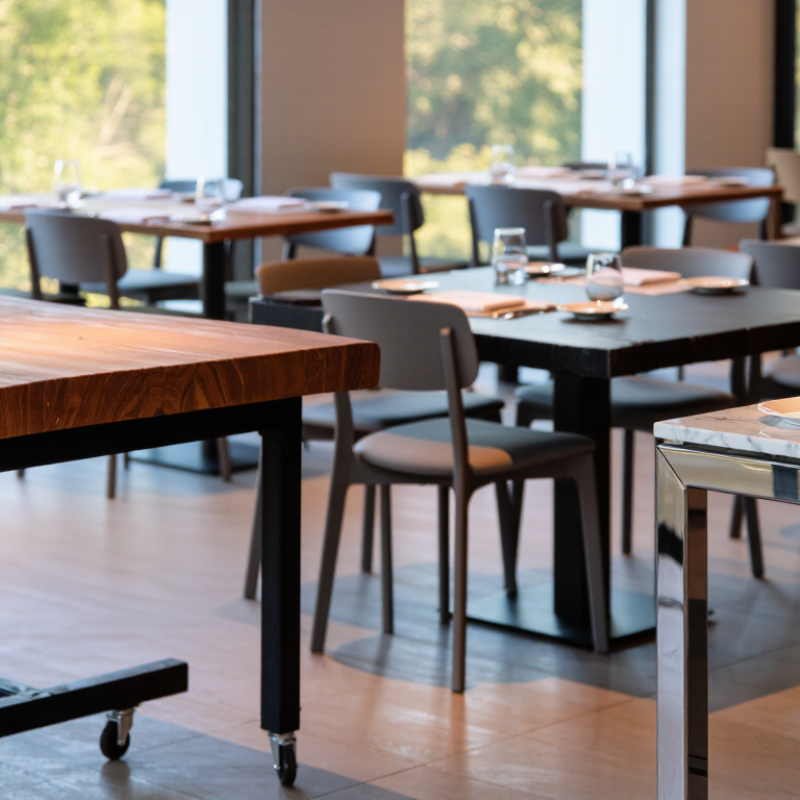
Understanding China’s Restaurant Furniture Table Supply Industry
Understanding China’s Restaurant Furniture Table Supply Industry
China’s restaurant furniture table supply industry combines material sourcing, factory production, surface finishing, and export logistics. Suppliers may specialize in solid wood, metal frames, compact laminate, or mixed-material designs. These choices affect more than appearance. A heavy oak table feels stable in a dining room, while a compact laminate top may be easier to wipe between busy lunch services.
Production capacity varies widely. Some factories handle custom dimensions and small trial orders; others focus on repeatable, high-volume runs. Ask how table legs are joined, how edges are sealed, and what checks happen before packing. Request samples or clear photos of finished details. A polished product image cannot reveal a wobbly joint. I’ve found that specifications are easy to overlook when comparing quotes, and that is worth correcting early. Confirm packaging dimensions, replacement-part options, and delivery estimates in writing.
Tips:
Share a floor plan and target table sizes before requesting prices. Check samples under warm indoor lighting, not only in a bright showroom. Ask whether quoted prices include packaging and freight. Small differences matter. A few millimeters can affect chair clearance, and a finish that looks perfect online may feel too glossy in person.
How Restaurant Furniture Tables Are Designed and Manufactured
China Top 10 Restaurant Furniture Table Suppliers
Restaurant tables begin with use, not decoration. Designers study dining space, chair clearance, cleaning routines, and expected turnover. The 2024 National Restaurant Association report projected U.S. restaurant sales above 1 trillion dollars. That scale demands furniture that performs repeatedly, not only furniture that photographs well.
Manufacturers usually create CAD drawings before cutting materials. They test laminate edges, welded joints, fasteners, and surface resistance. BIFMA performance standards provide useful references for commercial furniture durability and stability. A production team may use kiln-dried wood, powder-coated steel, compact laminate, or engineered stone, depending on budget and moisture exposure. Table height commonly stays near 750 millimeters, but accessible layouts require more careful knee space. Small measurements matter.
Factories then build a sample, inspect its load points, and revise the construction. Packaging tests are also necessary because shipping damage can erase a good design. The World Bank’s Logistics Performance Index shows that transport reliability remains a major supply-chain concern, making export packaging part of manufacturing quality. I have seen attractive prototypes fail because leveling feet were weak or edges felt sharp. The lesson is uncomfortable: a lower-cost table may become expensive after repairs. Suppliers should provide material specifications, test records, moisture guidance, and clear replacement procedures. A perfect table does not exist. Reliable improvement does.
Key Factors for Evaluating China’s Leading Table Suppliers
China Top 10 Restaurant Furniture Table Suppliers
China supplies roughly 37% of global furniture production, according to CSIL’s World Furniture Outlook 2024. This scale creates choices, but not every supplier fits restaurant use. Evaluate table suppliers through verified production evidence, not catalog photography. Request a recent factory audit, ISO 9001 records, material certificates, and export references. Check whether the workshop controls moisture, welding, edge sealing, and surface finishing.
Ask for a full-size sample. Test its stability on an uneven floor. Inspect weld beads, screw alignment, laminate edges, and underside protection. For outdoor tables, request corrosion testing and weathering data. For indoor dining rooms, compare scratch resistance and cleaning performance. A supplier should explain its tolerance limits clearly. Vague answers deserve caution.
CSIL also reports that commercial furniture demand increasingly values durability and flexible layouts. Therefore, measure nesting efficiency, replacement-part availability, and carton performance. Confirm lead times using production schedules, not promises. Packaging should protect corners during long-distance shipping, where small cracks become expensive claims. Pricing needs a full landed-cost review, including tooling, inspection, freight, duties, and spare units. Low quotes can hide weak steel, inconsistent color, or excessive defects. That happened in one project I reviewed. The sample was excellent; the bulk order was not. A second inspection before shipment would have helped. Supplier evaluation is never perfectly objective. Keep written scoring records, photographs, and test results for every candidate.
Profiles of 10 Notable Restaurant Furniture Table Suppliers in China
China Top 10 Restaurant Furniture Table Suppliers
China’s restaurant table market includes many specialized manufacturers. The following ten profiles reflect practical supplier strengths.
1. A Foshan workshop focuses on solid wood dining tables and hand-finished edges.
2. A Shunde manufacturer produces steel bases for busy restaurant interiors.
3. A Dongguan supplier makes compact laminate tables for easy cleaning.
4. A Shanghai contract supplier supports large hospitality projects and custom dimensions.
5. A Ningbo exporter offers flat-pack tables with reinforced shipping protection.
6. A Hangzhou workshop creates minimalist tables using oak, ash, and metal.
7. An Xiamen supplier specializes in weather-resistant aluminum tables for outdoor dining.
8. A Qingdao manufacturer combines sintered stone tops with durable frames.
9. A Chengdu workshop creates rustic tables from reclaimed timber and natural finishes.
10. A Guangzhou supplier provides mixed-material tables with relatively short production schedules.
In my experience, reliable sourcing requires more than attractive photographs. Ask for material samples, load-test records, moisture ratings, and detailed production drawings. Check whether table edges feel smooth and stable. Small defects often appear only after repeated cleaning. One weakness remains: delivery estimates can change during peak seasons. Confirm packaging methods and replacement procedures before placing an order.
Tips: Compare at least three samples under restaurant lighting. Measure aisle space before choosing table widths. Request a written finish standard. Verify certifications relevant to your market. A good supplier should explain limitations clearly, not promise everything.
Typical Restaurant Table Heights
This industry-reference chart compares common table-height categories, not individual suppliers. Typical ranges are approximately 71–76 cm for dining tables, 86–91 cm for counter-height tables, and 102–107 cm for bar-height tables. Bars show the midpoint of each range.